Wellness explainer · 7 October 2026 · 6 min
What "wellness real estate" actually means?
Wellness real estate is not a label to trust or distrust. It is a set of questions, and the six dimensions are a good way to ask them.

If you have looked at new launches in Dubai or Abu Dhabi recently, you have seen the words everywhere: wellness-led, healthy living, longevity, biophilic. Some of it is real. Some of it is a gym and a spa with a new name.
So what does wellness real estate actually mean? The word that matters in the definition above is intentional. A building with a pool is not wellness real estate. A building designed around how people will live in it, day after day, might be.
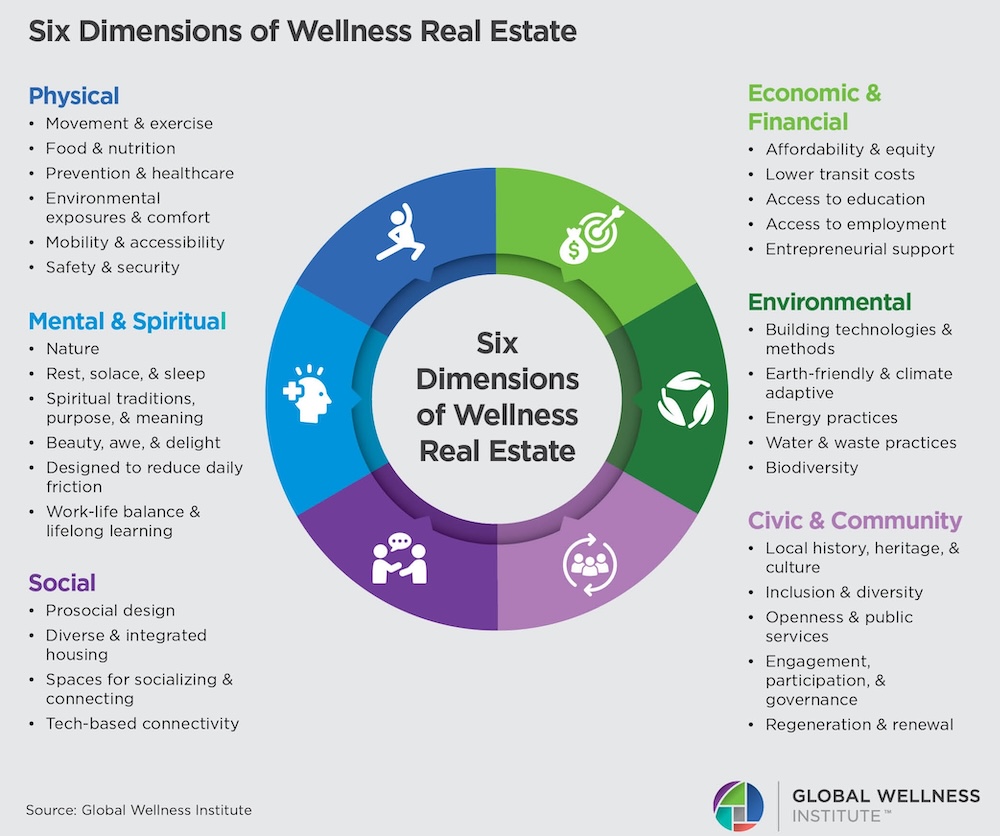
The Global Wellness Institute (GWI), the main research body for this industry, breaks this down into six dimensions in its Build Well to Live Well research. I use them as a checklist when I look at any project, and you can too.
1. Physical
This is the one most people think of first, but it goes beyond the gym. It covers movement and exercise, food and nutrition, access to preventive health, environmental comfort (air, water, temperature), how easy it is to get around, and safety.
The question to ask: does daily life here make it easy to move, breathe well and feel safe?
For me, it looks like this. I live in Dubai Hills and use the park every day to exercise. My favourite mall in the city is close by, and the location is central enough that I can reach almost anywhere in 20 minutes or less. None of it is a feature in a brochure. It is simply what makes healthy habits easy to keep, week after week.
A park you walk to every morning does more than a gym you never use.
2. Mental and spiritual
This dimension covers connection to nature, rest and sleep, a sense of purpose, beauty, less friction in daily life, and a healthy balance between work and the rest of life.
In a building, that translates into natural light, quiet, views and sleep-friendly layouts. It also depends on how close you are to the facilities that matter for your wellbeing: the park, the gym, the places where you meet friends, the clinic, the shops you actually use. When they are all within a short, easy trip, you spend less energy on logistics and more on the things that recharge you.
This is also where my idea of a "blue zone" lives: the place where the things that give you fulfilment, energy and joy are close enough to enjoy every week.
3. Social
People live better when they are connected. This dimension looks at design that encourages contact, a mix of residents, spaces to meet, and the use of technology to stay connected.
The question: are there places where neighbours naturally meet, or is the building a row of closed doors? Shared outdoor space, walkable streets and community programming are the signs to look for.
4. Financial and economic
GWI frames this dimension around affordability, lower transport costs, access to education and work, and support for local business. For a buyer, I read it more practically: what does it cost to live here beyond the purchase price, and how deep is the demand for this kind of home?
For an investor, location is the heart of this dimension. A home in an area people already want to live in, close to the things they use every day (parks, transport, schools, work, shops), tends to have stronger tenant demand and a larger pool of future buyers. That matters whether you plan to rent the property or sell it later. Before you invest, ask whether the demand around the property is real and likely to last, not only whether the unit looks good on paper.
Research cited in Fitwel's case study on Aldar's Fahid Island points in the same direction. It suggests that quality outdoor space can lift rents by up to 7%, and that homes near transit can command rents up to 14% higher. These are "up to" figures and every project is different, but the pattern is clear: the places that help people live well are often the places people keep paying to live in.
5. Environmental
This covers how the building is made and run: construction methods, climate-adaptive design, energy, water and waste, and support for biodiversity.
In the UAE, that means looking at recognised certifications (LEED, Fitwel, Estidama, WELL), but also at how the design copes with heat, shade and orientation. A certificate is a useful starting point. What it actually certifies is worth reading closely, which is why I have written a separate guide to the main ones.
6. Civic and community
The last dimension looks outward. It covers local heritage and culture, inclusion, public services, community participation and regeneration.
The question: does this development give something back to the area around it, or does it only serve its own residents? A project that is part of a living neighbourhood tends to age better than one that is sealed off from it.
Why it matters now
Wellness real estate is still a small slice of the market. GWI estimates that in the UAE it was worth about US$1.44 billion in 2024, and that only around 1.35% of construction output had a wellness focus. It has been growing at roughly 23% a year since 2019, faster than construction overall.
That growth means more projects will use the language of wellness, and it will be harder to tell which ones have earned it. Six dimensions give you a way to ask better questions.
How to use this when you buy
You do not need to score every project out of six. A few practical steps are enough:
Start with yourself. Which two or three dimensions matter most to you, or to your family? For one buyer it is daily movement and the sea. For another it is quiet and sleep.
Ask for evidence, not adjectives. "Biophilic" is a word. A floor plan with cross-ventilation and shaded outdoor space is evidence.
Look at the place, not only the unit. Light, noise, access and green space are properties of the location as much as the building.
Check how the building will be run. Programming, maintenance and service quality decide whether the features are still there in five years.
If you are investing, read the same dimensions as drivers of tenant demand, retention and resale.
None of this replaces the commercial basics: entry price, payment terms, future supply, service charges and the developer's record. It sits alongside them. A beautiful project at the wrong price is still the wrong decision.
A simple starting point
Wellness real estate is not a label to trust or distrust. It is a set of questions, and the six dimensions are a good way to ask them.
If you are weighing a home or an investment in Dubai or Abu Dhabi and want to test a project against them, send me a short brief. Everything always starts with the decision.
Editor
Luis Coutinho
Wellness real estate advisor - The Wellness Broker — Dubai & Abu Dhabi.
References
Global Wellness Institute (2025). Build Well to Live Well: The Future of Wellness Real Estate and Communities. Global Wellness Institute, Miami, FL. https://globalwellnessinstitute.org/industry-research/build-well-to-live-well/ (accessed 7 October 2026). Source of the six dimensions of wellness real estate.
Global Wellness Institute (n.d.). Wellness Real Estate. https://globalwellnessinstitute.org/what-is-wellness/what-is-wellness-lifestyle-real-estate-communities/ (accessed 7 October 2026).
Johnston, K. (2025). The Global Wellness Economy: United Arab Emirates (2019-2024 Data). Global Wellness Institute, Miami, FL. https://globalwellnessinstitute.org/geography-of-wellness/wellness-in-the-united-arab-emirates/. Source of the definition of wellness real estate and the UAE market figures (US$1.44 billion in 2024; 1.35% of construction output; growth of about 22.8% a year, 2019-2024).
Fitwel (2025). Fahid Island, Abu Dhabi: The First Certified Island Community by Aldar. Fitwel case study, Aldar Properties. Source of the figures on outdoor space (rents up to 7% higher) and proximity to transit (rents up to 14% higher).