Market analysis · 9 October 2026 · 7 min
Dubai 2040: what the plan promises, how impacts your decision
The Dubai 2040 Urban Master Plan explained for investors: what the government wants to build, what has moved so far, and what to watch before you buy.
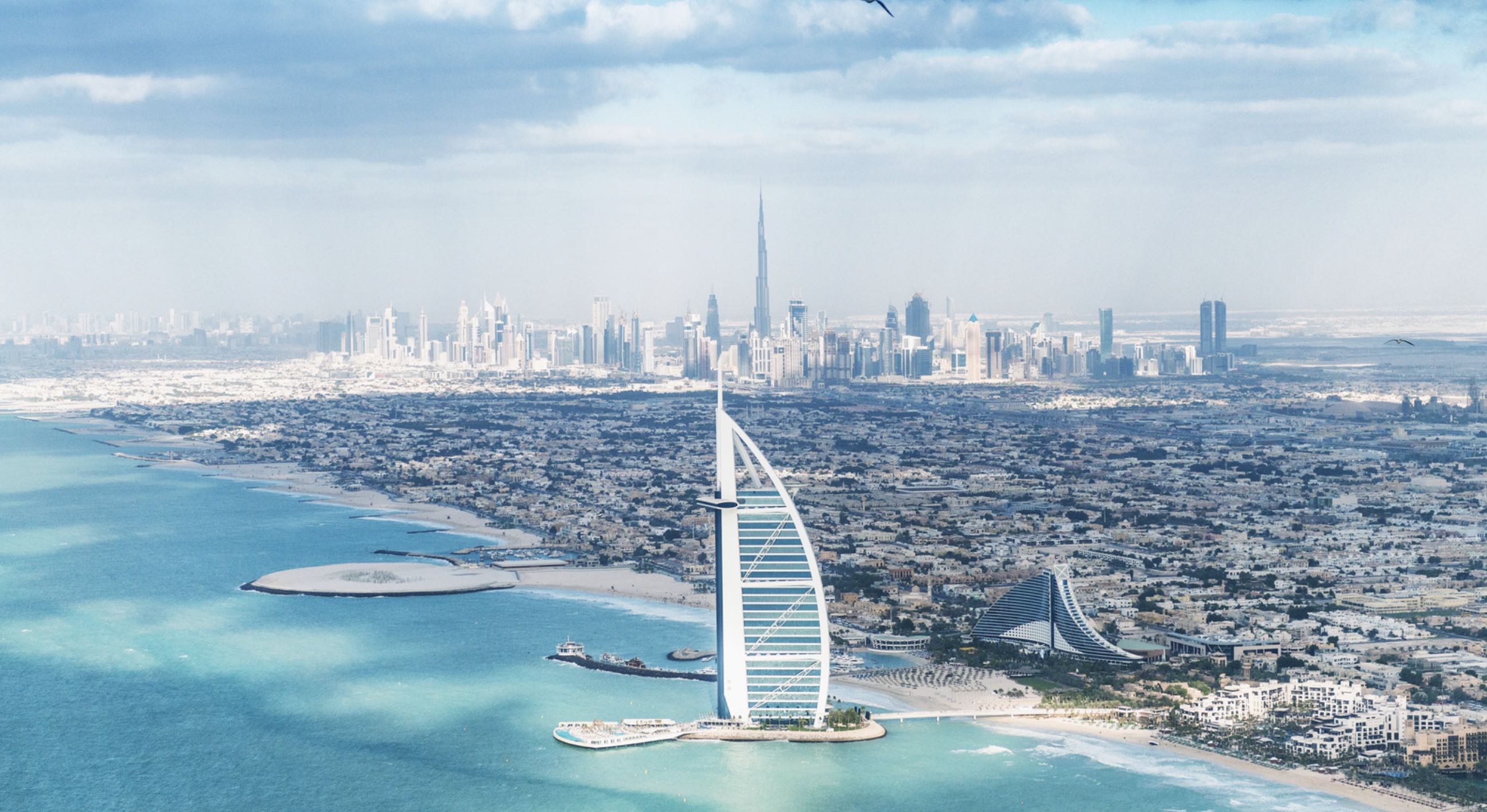
The Dubai 2040 Urban Master Plan is the government’s long-term plan for how the emirate will grow and where. It was announced in March 2021 and formalised by law in 2023. It sets targets for population, land use, public transport, green space and beaches, and it plans for around 5.8 million residents by 2040.
If you are thinking of investing in Dubai, Dubai 2040 is the document that shows where the city intends to put its money. You do not need to read the whole plan. You do need to know what it says, what is already happening and what could slow it down.
The Dubai 2040 Urban Master Plan is a visionary roadmap designed to guide the emirate's sustainable urban development over the next two decades. Launched by His Highness Sheikh Mohammed bin Rashid Al Maktoum, the plan aims to enhance the quality of life for residents while reinforcing Dubai's position as one of the world's leading cities for business, tourism, and innovation. It represents the seventh urban development plan in Dubai's history and aligns with the emirate's long-term economic, social, and environmental ambitions.
At the heart of the master plan is a people-centric approach that prioritizes livability, connectivity, and sustainability. The strategy focuses on creating vibrant communities with easier access to essential services, expanding green and recreational spaces, and promoting sustainable mobility solutions.
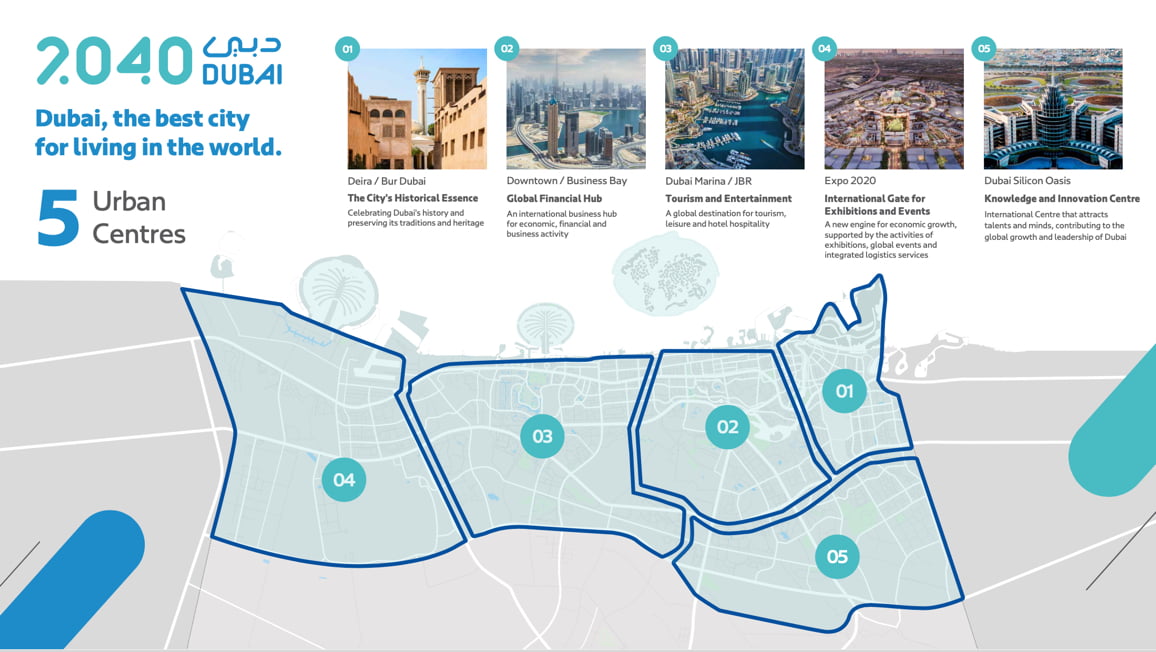
Source: Dubai 2040 website: projects and initiatives 5 urban centers.
Why Dubai 2040 matters when you buy
Understanding the Dubai 2040 Urban Master Plan is essential when evaluating a property purchase, whether for personal use or investment purposes. The plan provides valuable insight into how different areas of Dubai are expected to develop over the coming years, including new infrastructure, transportation networks, green spaces, business districts, and residential communities. These factors can significantly influence property values, rental demand, and long-term quality of life.
For homebuyers, the Master Plan helps identify locations that will benefit from improved connectivity, enhanced amenities, and sustainable urban development, ensuring that a property remains desirable for years to come. For investors, it offers a strategic framework for spotting emerging growth areas before they reach their full potential, creating opportunities for stronger capital appreciation and rental yields.
In a rapidly evolving city like Dubai, purchasing a property without considering future urban development can mean overlooking important opportunities or risks. By aligning investment decisions with the Dubai 2040 vision, buyers can make more informed choices and position themselves to benefit from the city's long-term growth strategy.
If you are buying to live
You will spend most of your time there. Where you live shapes your days: how long you commute, whether you can walk to a park, a school or a doctor. The 20-minute city idea is about exactly this.
You can see what your neighbourhood will become. A planned metro station, park or new centre nearby changes daily life. Knowing this before you buy avoids surprises, good or bad.
Quality of life tends to hold its value. Streets that are green, walkable and well served by transport are places people want to stay in, which supports the home you may one day sell.
If you are buying to invest
It shows where demand is heading. Tenants and future buyers follow transport, jobs and services. Being close to where the city is investing is a stronger starting point than guessing.
It supports both rent and capital growth. Rents rise where demand is real, and an area that is valued by the people living there is easier to rent and to sell later.
It helps you separate announcements from delivery. Not every project on a plan gets built on time. Knowing what is funded and under construction helps you judge risk and avoid paying today for something that may arrive much later.
It gives you a long-term frame. Dubai’s population has doubled in about 14 years. Understanding where the city intends to put the next million residents helps you choose a location with a purpose and not by fashion.
In both cases, the plan does not replace a good decision. It gives you better questions to ask about a location before you commit.
What Dubai 2040 sets out to do
The plan’s main targets, according to the official summaries, are:
Population: from about 3.3 million residents in 2020 to 5.8 million by 2040.
Five urban centres: Deira and Bur Dubai, Downtown and Business Bay, Dubai Marina and JBR, plus two newer ones, Expo City Dubai and Dubai Silicon Oasis.
The “20-minute city”: daily needs (work, school, shops, health care, leisure) reachable on foot or by bike. About 55% of residents are meant to live within 800 metres of a main public transport station.
Nature and public space: around 60% of the emirate set aside as nature reserves and wildlife sanctuaries. The plan also targets a 105% increase in green space and parks, a 400% increase in public beach area and 110 km of new coastline.
Economy: land for economic and industrial activity expanded to 168 square kilometres. Land for education and health facilities is meant to grow by 25%.
I’d read the plan as a statement of priorities. Dubai wants to be a city where you can live well without a long commute, and not only a place to visit.
What it means for investors
I would look at three things.
Location. Where the plan puts new centres, stations and parks will shape which neighbourhoods get demand over time. Rents rise where people want to live. In my experience, being close to transport, schools, health care and green space is what makes demand last.
Quality of life. The plan puts walkability, green space and public beaches at the centre. That is the same thinking behind wellness-led residential, and it is why I treat location as part of the investment case.
Timing. A plan sets a direction and does not fix dates for each neighbourhood. The question is when a specific area will feel different, and that depends on the projects that are actually under construction.
Can Dubai deliver it?
The Dubai 2040 Urban Master Plan is undoubtedly ambitious, but Dubai has built a global reputation on transforming bold visions into reality. Over the past two decades, the emirate has successfully delivered world-class infrastructure projects, iconic developments, and large-scale urban initiatives that many once considered impossible. This track record gives investors and residents confidence that the city possesses both the expertise and determination needed to execute long-term strategies.
However, delivering the Master Plan will require more than landmark projects. Dubai must carefully manage population growth, transportation demands, environmental sustainability, and housing affordability while maintaining its attractiveness as a global business hub. The challenge lies not only in building new infrastructure but also in creating resilient, connected, and highly livable communities.
While no long-term urban strategy is guaranteed to unfold exactly as planned, Dubai's history suggests that the emirate is uniquely positioned to turn ambitious goals into tangible outcomes. For property buyers and investors, this combination of vision, execution capability, and continued economic growth is one of the key reasons why the Dubai 2040 Master Plan deserves close attention.
What points in its favour
A record of delivery. Dubai has built the metro, the Palm Jumeirah and Expo 2020 (now Expo City Dubai), and it has repurposed Expo City as a permanent district. This is a government that completes large projects.
Funded and visible infrastructure. The Dubai Metro Blue Line is 30 km long with 14 stations and is due to open on 9 September 2029. It had reached 12% completion in December 2025, and the RTA expects 30% by the end of 2026. It is explicitly part of the 2040 plan.
Demand is real. Dubai’s population reached 4 million in August 2025, having doubled in about 14 years. At that pace the city could approach the 2040 figure of 5.8 million earlier than planned, according to Khaleej Times.
Early planning steps are done. The committee overseeing the plan reports over 17,400 residential plots planned for citizens, a new Urban Planning Law, and masterplans for the desert and rural areas and for public beaches.
My view: the direction is credible, and the infrastructure that is funded and under construction is the best evidence. The most ambitious goals will take longer, so I would build a case on what exists today and treat the rest as upside.
If you want help comparing areas against the Dubai 2040 plan, get in touch. Everything always starts with the decision, so tell me what you are trying to achieve and I will build the research around it.

Editor
Luis Coutinho
Wellness real estate advisor - The Wellness Broker — Dubai & Abu Dhabi.
References
Dubai Media Office (2025). Supreme Committee for Urban Planning
Bayut. All you need to know about the Dubai 2040 Urban Master Plan
Gulf News (17 December 2025). Dubai Metro Blue Line reaches 12 per cent completion, on track for 2029 launch
Khaleej Times (2025). Dubai’s population reaches 4 million
Khaleej Times (20 August 2026). Dubai set for highest annual home deliveries since 2008 as new launches slow