Wellness explainer · 7 November 2026 · 7 min
The 3-30-300 Rule: Three Simple Numbers for Living Closer to Nature
The 3-30-300 rule, proposed by Dutch urban forester Cecil Konijnendijk, sets three simple benchmarks: three trees visible from home, 30% tree canopy in the neighbourhood, and a quality green space within 300 metres. This article explains where the rule comes from, what the health research shows (and doesn’t), and how to use it as a practical checklist when choosing where to live.

What it is, who created it, what the evidence says about health, and what it means for the communities we live in.
3-30-300 Where the rule comes from
Cecil Konijnendijk is a Dutch urban forester who has spent more than two decades studying how cities can be greened. He co-founded the academic journal Urban Forestry & Urban Greening in 2002 and has edited several standard textbooks on urban forestry. He also co-leads the Nature Based Solutions Institute, a think tank focused on evidence-based urban greening.
Around 2021, Konijnendijk noticed that existing guidelines for green space were scattered across different countries and measured different things. He reviewed them and proposed a single, simple benchmark, which he called the 3-30-300 rule. He later described it as a moment of serendipity rather than the result of a long plan.
The rule has three parts:
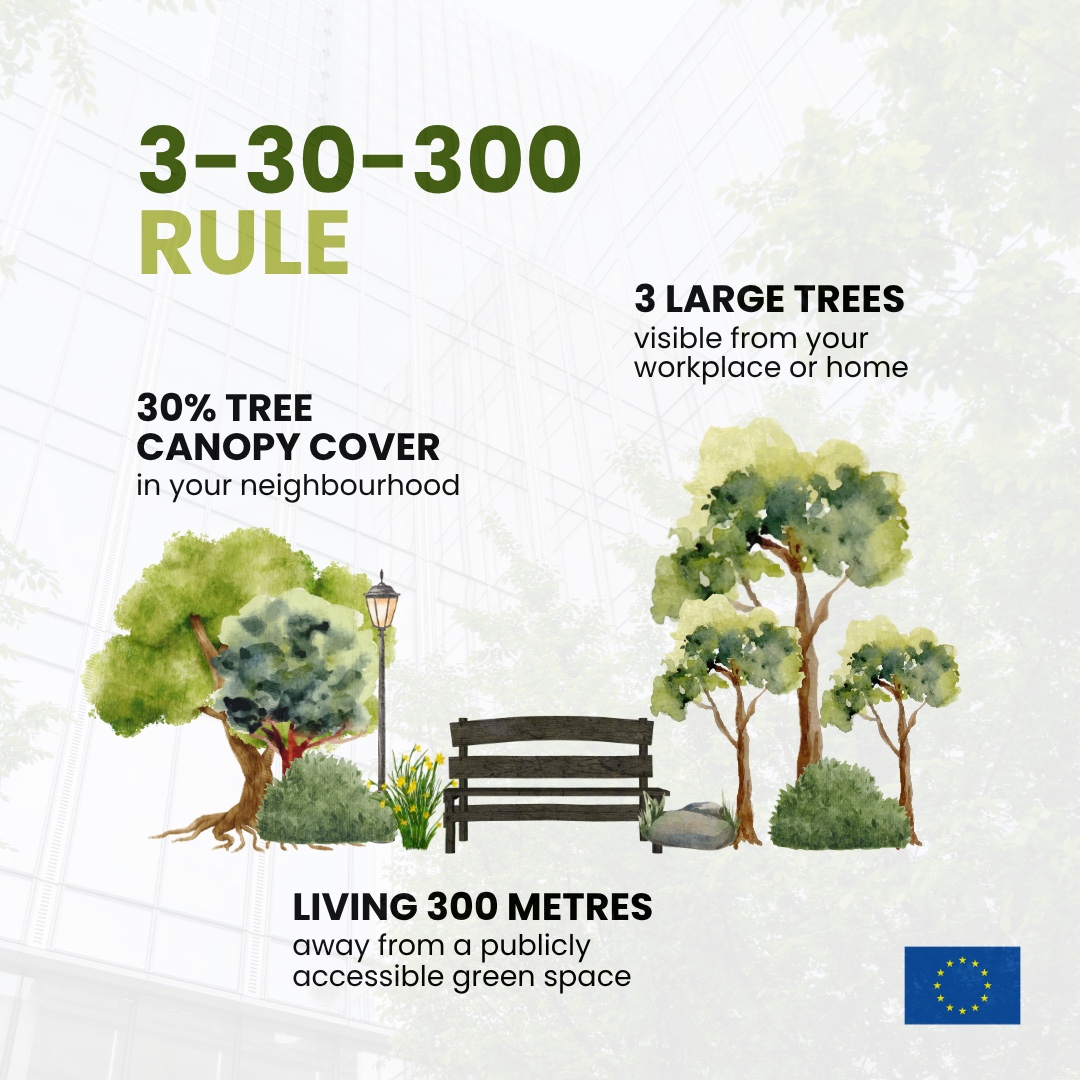
3 trees visible from every home. Everyone should be able to see at least three well-established trees from their home, school, or workplace.
30% tree canopy in every neighbourhood. Each neighbourhood should have at least 30% of its area covered by tree canopy or significant vegetation.
300 metres to a quality green space. Everyone should live no more than 300 metres from a high-quality, publicly accessible park or green space. That is roughly a five-minute walk.
What makes the rule useful is that it is easy to remember and easy to measure. A planner, a resident or a developer can check it against a map.
Why these numbers
Konijnendijk did not pick the numbers at random. Each one targets a different way that people experience nature.
The three trees is about the view from your window. Research on daily life suggests that people benefit from nature they see, not only from nature they visit. A tree outside a kitchen window is part of your day even if you never go outside.
The 30% canopy is about the neighbourhood as a whole. Trees cool the air, provide shade on pavements and reduce the heat that builds up in streets. This is the target that most cities find hardest to reach.
The 300 metres is about access. A park you can reach on foot is used. A park that requires a car is used far less, and the people who most need green space are often the ones who can least afford to drive to it.
What the health evidence says
The strongest study so far on the rule was published in 2022 in Environmental Research. A team led by Mark Nieuwenhuijsen at the Barcelona Institute for Global Health (ISGlobal) analysed data from 3,145 adults aged 15 to 97 who took part in the Barcelona Health Survey in 2016 and 2017.
The results were revealing in two ways.
First, very few people met the full rule. Only 4.7% of the people surveyed met all three criteria. Many more had one of the three, but almost none had all three. The researchers were clear that this is a sign of how little green space the city has, not a fault of the people living there.
Second, for those who did meet the full rule, the researchers found associations with better health. People who met all three criteria reported better mental health, used less medication and visited psychologists and psychiatrists less often. The link with fewer psychologist and psychiatrist visits was statistically significant. The other links were in the same direction but were not statistically significant on their own.
It is important to be honest about what this study shows. It is a cross-sectional study, which means it captures a snapshot in time. It shows an association, not proof that green space causes better mental health. Other things, such as income, neighbourhood and lifestyle, could also play a role, even though the researchers adjusted for some of them. Still, the findings match a growing body of research on urban green space and wellbeing.
Heat is another piece of the health picture. A 2024 study in Urban Forestry & Urban Greening by Gillerot and colleagues looked at how urban tree canopy reduces human heat stress. For a region like the Gulf, where summer heat is a daily health issue, that link matters.
Across Europe, the picture is mixed. A study covering 862 European cities found that about 47% of residents could see at least three trees from home, around 28% lived in neighbourhoods with sufficient canopy, and about 57% were within reach of a park. Over a single decade, many cities saw their green areas shrink while their populations grew.
The benefits for the community
The rule is not only about individual health. It also changes how a neighbourhood works.
Walkability. When green space is within 300 metres, people walk more. Walking is one of the simplest ways to build physical activity into daily life, and it doesn’t require a gym membership.
Social life. Parks, shaded streets and public spaces are where neighbours meet. Research on green space often finds that it supports social ties, which in turn support wellbeing. Blue Zones research, led by Dan Buettner, points in the same direction: long-lived communities tend to have strong social connections and daily routines that involve movement.
Climate resilience. Trees reduce heat, absorb rainwater, and improve air quality. A neighbourhood with a good canopy is cooler in summer and more comfortable to live in.
Property and reputation. Communities that meet green benchmarks often become more attractive to buyers. In the United States, some Blue Zones-certified communities have reported that the label supports their appeal, although this is a marketing effect that should be assessed carefully rather than assumed.
The challenges
The rule is not without critics, and it is worth knowing where it struggles.
The 30% target is hard in dense and hot cities. Achieving 30% canopy in a compact, arid city requires water, careful species selection, and long-term maintenance. Konijnendijk himself has acknowledged that the target is ambitious and that local conditions matter.
Visibility is not use. Seeing trees from your window is not the same as using a park. A park 300 metres away can still go unused if it feels unsafe, poorly maintained or unwelcoming.
It is a guideline, not a standard. Cities that use the rule adapt it to their context. Some apply the distance and visibility criteria but treat the canopy target as a long-term goal.
These are fair points, and they make the rule more useful, not less. It is a diagnostic tool: it shows where a neighbourhood falls short and where the next investment should go.
What this means in the UAE
The 3-30-300 rule is an interesting lens for Dubai and Abu Dhabi, where the climate makes trees a major investment and where urban planning is moving quickly.
Dubai Municipality’s Blue and Green Spaces Roadmap, launched at the World Governments Summit, includes a portfolio of projects worth more than AED 4 billion. Over five years, it aims to plant 1.5 million trees, create 120 new parks across nearly 3 million square metres, and weave more than 200 sports and recreational spaces into green networks across the city. Those are the kinds of projects that determine whether a neighbourhood meets the rule in practice.
For anyone choosing where to live or invest, the rule offers a practical checklist. It doesn’t replace financial analysis, and it doesn’t predict property prices. But it gives a structured way to ask:
Can I see trees from my home? Look at the view, the orientation and the building’s landscaping, not only the marketing images.
How green is the neighbourhood? Check the mature trees, the planted streets and the parks, and walk the area at different times of day.
How far is a quality green space? Measure the walking route, not the straight line on a map. Check that the park is open, maintained and used.
These questions are not guarantees of wellbeing or value. They are a way to see what a place actually offers, beyond the brochure.
The takeaway
The 3-30-300 rule is simple on purpose. Three trees from your window, 30% canopy in your neighbourhood, and a green space within a five-minute walk. Each target is measurable, each one connects to a different part of daily life, and together they describe a place where people are more likely to move, meet others and feel well.
The evidence is still developing, and the rule should be used as a guide rather than a guarantee.
But it gives planners, residents and buyers a clear question to start with: does this place make it easy to live closer to nature?

Editor
Luis Pedro Coutinho
Pharmacist and wellness real estate advisor, The Wellness Broker — Dubai & Abu Dhabi.
References
Cecil Konijnendijk: Wikipedia and his 2021 presentation “Threes for trees: the 3:30:300 rule for greener and healthier cities”
Nieuwenhuijsen MJ et al. (2022). “The evaluation of the 3-30-300 green space rule and mental health.” Environmental Research, 215, 114387. DOI: 10.1016/j.envres.2022.114387. Summary by ISGlobal.
Gillerot L et al. (2024). “Urban tree canopies drive human heat stress mitigation.” Urban Forestry & Urban Greening, 92.
Dubai Municipality Blue and Green Spaces Roadmap, reported by Zawya.
Ave Maria (Florida) Blue Zones certification press release, January 2025.